Bank Rate Rises to 4%: What It Means for Small Businesses
By Phoebe Brunnock, Head of Digital Marketing at Cubefunder. Published 5th November 2026.
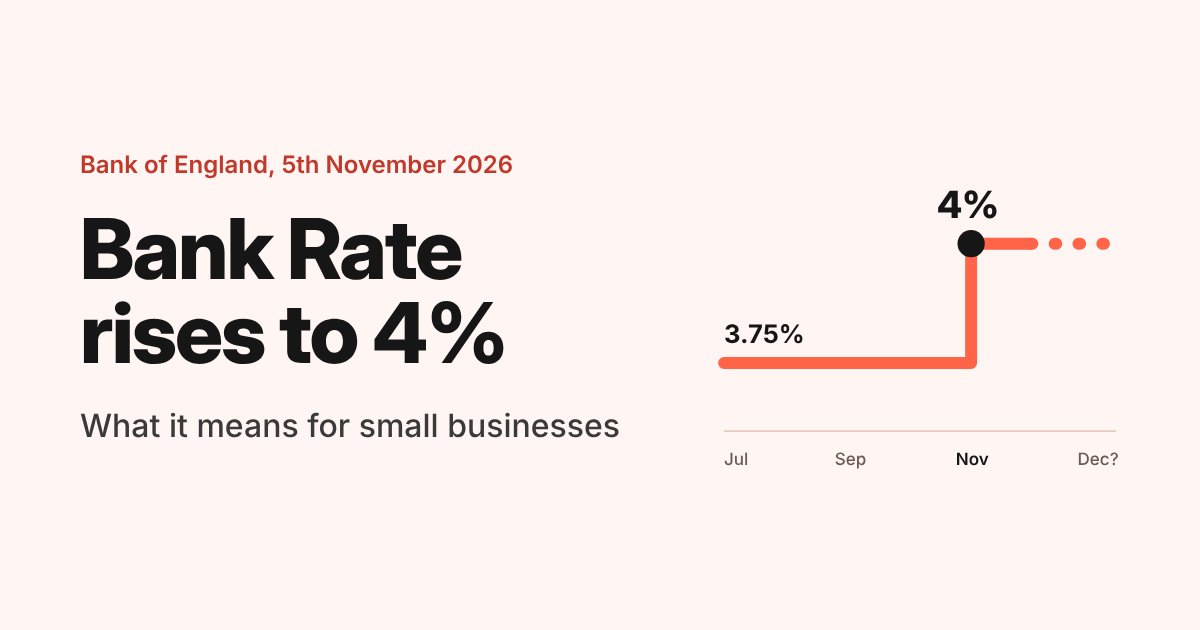
Key takeaway: On 5th November 2026 the Bank of England raised Bank Rate by 0.25 percentage points to 4%, after holding at 3.75% in July and September. Variable-rate loans and overdrafts are likely to cost more; fixed-rate loans you already have won’t change. HMRC’s late payment interest is set at Bank Rate plus 4%, so it rises to 8%. The next decision is due on 17th December 2026.
The Bank of England has raised interest rates. On 5th November 2026, Bank Rate rose from 3.75% to 4%, after being held at its July and September meetings.
A quarter of a percentage point sounds small. But this Bank Rate rise feeds into the cost of overdrafts, variable loans, HMRC late payment interest and your customers’ spending. And it lands just before a VAT deadline.
This guide explains what changed, why the Bank acted, and what it means for your borrowing and cash flow. It finishes with practical steps you can take this week.
What did the Bank of England announce on 5th November 2026?
The Bank of England’s Monetary Policy Committee raised Bank Rate by 0.25 percentage points, from 3.75% to 4%, on 5th November 2026 (Bank of England).
Bank Rate (often called the “base rate”) is the interest rate the Bank of England pays on money that banks and building societies hold with it. It sets the floor for much of the borrowing and saving in the UK economy. When it goes up, lenders usually raise the rates they charge on loans and pay on savings.
| Measure | Before | After |
|---|---|---|
| Bank Rate | 3.75% (held 17th September 2026) | 4% (from 5th November 2026) |
| UK inflation (CPI) | – | 3.5% |
| Inflation target | 2% | 2% |
| Next decision | – | 17th December 2026 |
Figures as of 5th November 2026. Source: Bank of England.
Why did the Bank raise interest rates?
The Bank raised rates to stop high energy prices spreading into prices across the wider economy. According to the Bank, conflict in the Middle East has disrupted the supply and transport of energy. That has pushed up fuel costs and utility bills.
The Bank’s main points, as of 5th November 2026:
- Inflation is rising. It has reached 3.5% and the Bank expects it to rise to about 5% by mid-2027.
- Knock-on effects are expected. So far there’s little sign of higher energy costs pushing up other prices and wages. But the Bank thinks energy has been expensive for long enough that those effects will come.
- The economy is stronger than expected. That’s good news, but it adds to the risk that businesses pass higher energy costs on in their prices.
Governor Andrew Bailey said the rise “shouldn’t be seen as the first in an inevitable long sequence of hikes”. But he also said it seems unlikely to be the last unless the conflict is resolved. The Committee will decide at each meeting.
What this means for you: nobody knows where rates go next. Plan for rates staying at 4% or rising further, rather than counting on a cut.
What does the base rate rise mean for business loans?
It depends on whether your borrowing is fixed or variable. Variable-rate borrowing will usually get more expensive; fixed-rate loans you already have won’t change.
| Type of borrowing | How the rise affects you |
|---|---|
| Variable-rate loan or overdraft | If it’s linked to Bank Rate, your rate is likely to rise, often from your next payment. Check your agreement for when changes apply. |
| Fixed-rate loan | Repayments stay the same for the agreed term. |
| Business credit card | Lenders may raise rates. Check for notice of changes. |
| New loans | Lenders may reprice new lending. Get quotes and compare the total repayable. |
| Asset or invoice finance | Depends on the agreement. Some are fixed, some vary with Bank Rate. |
A worked example
This example is illustrative only. It isn’t a quote, and the rates are hypothetical.
Imagine a business with a £40,000 variable-rate facility charged at Bank Rate plus 3%, fully drawn for a year.
| Bank Rate | Interest rate | Interest over a year |
|---|---|---|
| 3.75% (before 5th Nov) | 6.75% | £2,700 |
| 4% (now) | 7% | £2,800 |
| 4.5% (hypothetical) | 7.5% | £3,000 |
Today’s rise adds about £100 a year. That’s manageable on its own. But if rates kept rising, and costs like energy rose with them, the pressure would build.
Fixed repayments and Cubefunder loans
Cubefunder’s short-term business loans have a fixed cost of credit and a pre-agreed repayment plan. If you already have one, today’s decision doesn’t change what you repay. For a new loan, the full cost, including the total you’ll repay, is set out in each quote before you commit.
Fixed repayments don’t make a loan the right choice. They do make it easier to plan when rates are moving.
Does the rate rise make paying HMRC late more expensive?
Yes. HMRC charges late payment interest at Bank Rate plus 4%, so the rate rises from 7.75% to 8% (GOV.UK). HMRC applies new rates from a set date after each Bank Rate change, so check its interest rates table for when 8% starts.
The timing matters. VAT for the quarter ending 30th September 2026 is due by Saturday 7th November. Because the deadline falls on a weekend, the money must reach HMRC by Friday 6th November, unless you pay by Faster Payments (GOV.UK).
On an £18,000 VAT bill paid 60 days late, interest at 8% would be about £237, compared with about £229 at 7.75%. The bigger cost is the penalties: 3% at day 16 and another 3% at day 31, then 10% a year on what’s still owed (GOV.UK).
If you can’t pay in full, pay what you can now. It cuts the balance that interest and penalties are worked out on. Then look at HMRC’s Time to Pay or other options. Our guide to using a business loan to pay VAT compares them.
How else could higher rates affect your business?
Higher rates are designed to slow spending, so the effects reach your customers and suppliers as well as your own borrowing. The Bank explains that higher loan and mortgage payments leave people less to spend elsewhere.
- Customer demand: consumers with variable mortgages or loans may cut back. Businesses selling non-essentials could feel it first.
- Late payments: if your business customers face higher costs, some may pay you more slowly. That can open a cash-flow gap even when sales hold up.
- Energy and supplier costs: the rise is a response to high energy prices, which are already feeding into utility and fuel bills. Suppliers may pass costs on.
- Cash reserves: savings rates often rise after Bank Rate goes up. If you hold a cash buffer, it may be worth checking what it earns.
None of this is certain. The Bank itself says the economy has been more resilient than expected.
What should small businesses do now?
Start by finding out which of your costs move with Bank Rate, then plan your cash flow on the assumption that rates stay at 4% or higher.
- List your borrowing. For each loan, overdraft and card, note whether the rate is fixed or variable, and when any fixed period ends.
- Work out the extra cost. For variable borrowing, 0.25 percentage points on each £10,000 adds about £25 a year.
- Pay HMRC on time. If VAT is due on 7th November, make sure the money reaches HMRC by Friday 6th November, unless you pay by Faster Payments. If you can’t pay in full, contact HMRC before the deadline.
- Update your cash-flow forecast. Include higher energy costs and allow for customers paying later.
- Chase invoices early. A short delay on a large invoice can matter more than a rate change.
- Compare before you borrow. If you need finance, compare the total repayable, not just the headline rate. Fixed repayments can make budgeting easier.
- Get advice if things are tight. Your accountant or a free adviser such as Business Debtline can help.
The next rate decision is on 17th December 2026. Put it in your diary.
Frequently asked questions
What is the Bank of England base rate now?
As of 5th November 2026, Bank Rate is 4%. The Monetary Policy Committee raised it by 0.25 percentage points from 3.75%, to limit how far high energy prices push up other prices. Inflation is 3.5% against a 2% target. The next decision is due on 17th December 2026.
Will my business loan repayments go up?
Only if your loan has a variable rate linked to Bank Rate. Variable loans and overdrafts usually rise soon after a change, so check your agreement. Fixed-rate loans stay the same for the agreed term. Cubefunder loans have a fixed cost of credit, so existing repayments don’t change.
How much is HMRC late payment interest now?
HMRC charges late payment interest at Bank Rate plus 4%. With Bank Rate at 4%, that’s 8% a year, up from 7.75%. It’s charged from the first day a payment is overdue, on top of any late payment penalties. Check GOV.UK for the date the new rate applies.
Will interest rates go up again?
Nobody can say for certain. The Governor said this rise shouldn’t be seen as the first in a long sequence. He also said it’s unlikely to be the last unless the conflict in the Middle East is resolved. The Committee will decide at each meeting, next on 17th December 2026.
Should I get a loan before rates rise further?
Not just because rates are rising. Borrow only if you have a clear need and can afford the repayments alongside your other costs. If you do need finance, compare the total repayable across options. A fixed cost of credit can make repayments easier to plan while rates are changing.
The bottom line
The rise to 4% adds a modest cost to variable borrowing and makes paying HMRC late slightly more expensive. The bigger risk is what comes next: higher energy costs, slower customer spending and the chance of further rises. Know which of your costs move with Bank Rate, keep your cash-flow forecast up to date, and pay HMRC on time.
If you need funding with repayments that won’t change when rates do, see how our process works, then check your eligibility. It takes under a minute and won’t affect your credit score. We’ll call you within 30 minutes during working hours to talk through whether a loan is right for you at all.
This article is general information only, not financial or tax advice. Speak to your accountant or adviser about your circumstances. Cubefunder is a trading name of Tallaght Financial Ltd (company number 09261403). Tallaght Financial Ltd is authorised and regulated by the Financial Conduct Authority (FRN 786297). Loans to limited companies are not regulated by the FCA. All lending is subject to status.